Why finding the right AI use case is the only AI decision that actually matters
·12 min read

Everyone is building with AI. Very few are building the right things.
By 2026, more than 80% of enterprises are expected to have generative AI deployed in some form. Billions of dollars are flowing into pilots, proof-of-concepts, and AI product builds. Yet RAND Corporation’s 2025 analysis found that 80% of AI projects fail to deliver their intended business value. MIT’s Project NANDA put it even bleaker for generative AI specifically: 95% of organizations deploying GenAI saw zero measurable financial return.
That last number deserves a moment. Ninety-five percent. Not because the technology failed. The models work. The APIs are fast. The tooling has never been more accessible. The failure is strategic — companies choosing the wrong use cases, building solutions for problems that don’t exist at meaningful scale, or betting on ROI they have no real basis to expect.
If you’re leading a startup, advising companies on AI adoption, running a product team, or sitting in a boardroom trying to figure out where AI fits — this is the problem worth obsessing over.
The real reason AI projects fail: it’s not the tech
There’s a comfortable story that AI projects fail because the data isn’t ready, the infrastructure isn’t there, or the team lacks technical skill. Those things do derail projects. But they’re symptoms.
The root cause is almost always the same: teams start with a technology and work backward to find a use case, rather than starting with a real problem and working forward to the right tool.
Only 32% of companies properly identify which human tasks AI should supplement or replace before committing to a build. The rest make bets based on vendor demos, conference buzz, and competitive anxiety. Deloitte found that 42% of companies abandoned at least one AI initiative in 2025. The most common reason wasn’t a technical failure. It was that the business case evaporated once teams got close enough to the problem to see it for what it actually was.
The companies that succeed take use case selection seriously in a way most don’t. They define success criteria before writing a line of code. They ask specific questions: What’s the ROI benchmark for this category? Has this been deployed in a comparable context? What’s a realistic payback period? They don’t treat this phase as a formality before the real work begins. They treat it as the most important work.
The data backs this up. Projects with clear pre-approval success metrics succeed 54% of the time. Projects that skip that step succeed 12% of the time. That 42-point gap is decided entirely before a model is trained or a workflow is built.

What actually makes a good AI use case
The best AI use cases share a recognizable profile. Knowing it makes it much easier to sort real opportunities from AI for the sake of it.
High volume, clear structure
AI performs best when the underlying task is well-defined and happens constantly. Invoice processing, support ticket routing, document classification, lead scoring — these fit the profile. A task that happens twice a month with lots of variation is a weak starting point. The same task happening thousands of times daily with predictable inputs is where the math starts to work.
A metric you can actually move
The best use cases come attached to a specific number you can improve. Handle time. Headcount per unit of output. Error rate. Conversion rate. If you can’t say what “better” looks like in numbers before you start, you’re guessing. The ROI calculation doesn’t need to be precise — it needs to be grounded.
A human still in the loop, at least early
Fully autonomous AI decisions carry real risk, both technically and organizationally. The strongest early-stage use cases augment human judgment rather than replace it outright. This lowers the bar for adoption, reduces error exposure, and builds enough internal trust that people will actually use the thing before you push toward full automation.
Evidence that it’s been done before
One of the most underused advantages available to any team in 2026 is the fact that hundreds of real AI deployments have already happened. Finance teams have automated AP workflows. Support organizations have deployed deflection agents. Sales teams have built AI-driven lead scoring systems. That deployment data exists. Using it should be the first move, not an afterthought.
The cost of picking the wrong one
Bad use case selection doesn’t just waste the build cost. The damage compounds in ways teams rarely track.
Six months of engineering focus that could have gone to a use case with a faster payback. A failed pilot that makes the next AI initiative harder to fund and harder to staff. A C-suite that approved a promising initiative watching it dissolve — and drawing conclusions about the people who sold it to them. Each failed initiative also makes the organization more risk-averse about the next one, which means missed opportunities accumulate on top of the sunk costs.
The math on a bad use case is always worse than it first looks. The math on a good one almost always beats projections — because proven ROI in one area unlocks both budget and organizational appetite for the next initiative.
Picking the right use case the first time doesn’t just generate value from that specific project. It builds the credibility that makes every subsequent AI project easier to greenlight.
A framework for finding the right use case
Here’s how teams with strong AI track records approach this — whether they’re building internally or advising clients.
Start with the workflow, not the technology
Map your highest-cost, highest-volume workflows first. Where do people spend the most time on tasks that are largely mechanical? Where do errors cluster? Where does information get trapped in formats that slow decisions? The workflows with the most friction are almost always where AI generates the most value.
Build an evidence base before you commit
Before approving a build, find out whether this use case has been deployed in a comparable context. What ROI did they see? What was the implementation timeline? Where did things break? If you can’t find evidence that this has worked before, you’re not making a business decision. You’re making a research bet — and you should price it accordingly.
Stress-test the math at conservative assumptions
Build a rough model. What does the workflow currently cost in hours, headcount, or error rate? What’s a realistic reduction if the AI performs modestly — not the vendor’s best case, but a skeptic’s estimate? What does implementation cost, and how long until the math turns positive? If you can’t make the numbers work at conservative inputs, the use case probably shouldn’t be in the roadmap.
Pick a first use case you can measure in 90 days
The best first use case is rarely the biggest one. It’s the one where you can get to a real measurement within 60-90 days. Quick wins with clear data let you build internal credibility and sharpen your approach before taking on anything more complex.
Why scattered research is killing your AI strategy
Most teams already know they should evaluate use cases carefully. The problem is that the information required to do it well is scattered across white papers, analyst reports, vendor case studies, and conference talks — each with a different methodology, different ROI definitions, and different contexts that may or may not map to your situation.
Pulling that together manually takes weeks. Most teams don’t have weeks. They have a quarter to show something, a budget approval contingent on a credible business case, and a leadership team that’s genuinely tired of AI promises.
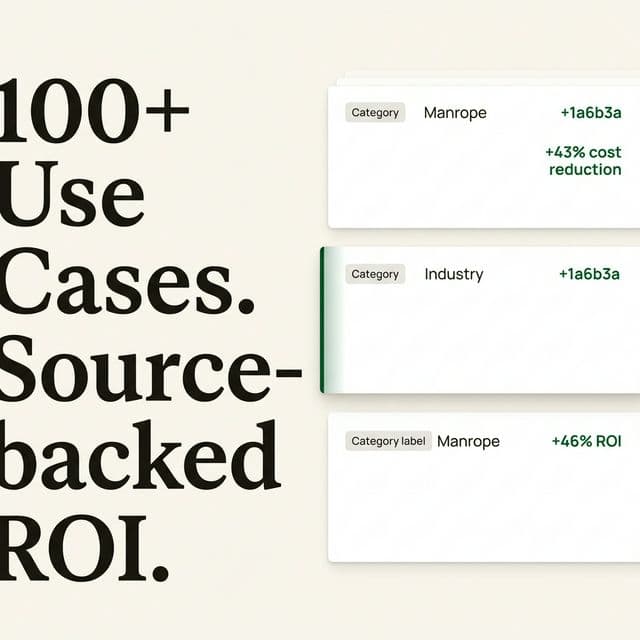
Case Ledger was built for exactly this gap.
It’s a database of 100+ AI use cases across 12 industries, organized for teams that need to move from research to decision without losing a month doing it. Each entry carries source-backed ROI benchmarks with methodology notes and links to the original public data, so you can judge the quality of the evidence yourself rather than taking a vendor’s word for it. Alongside the benchmarks, each entry includes real implementation context — what the deployment looked like, what data was required, what the timeline actually was. For the use cases that support it, Case Ledger also ships ready-to-deploy agents and workflows you can have running in hours.
The platform’s semantic search works in natural language, so you don’t need to already know the right terminology to find relevant use cases. And for teams building internal business cases, there’s a free ROI calculator for running a first-pass financial model before committing to anything.
Three weeks of triangulating evidence from sources of varying quality, or a well-structured business case you can walk into a budget meeting with. Case Ledger is the difference between those two outcomes — whether you’re a startup figuring out which AI capability to build into your product, a consultant building a client roadmap, an enterprise leader prioritizing competing AI investments, or a product manager who needs hard numbers to justify a line item.
Getting the use case right is the whole game
The graveyard of failed AI projects is real, and it is full of initiatives that started with a technology and tried to reverse-engineer a problem. The teams that are compounding real advantages in AI right now started from the opposite direction: a concrete problem, a clear success metric, evidence that it’s solvable, and a build only after that foundation was in place.
That discipline, applied consistently, changes the trajectory of every AI investment that follows. First-time success builds credibility. Credibility unlocks budget. Budget funds the next initiative with better data and better organizational trust. The gap between teams that get this right early and teams that don’t gets wider every quarter.
Start with the use case. Get it right. And if you want the evidence to make that call with confidence, Case Ledger is where that evidence lives.